Connecting regions, industry, and policymakers to strengthen policy capacity, align regional and industrial priorities, and provide a structured space for knowledge exchange
WHAT IS REGIOTEX?
RegioTex is a collaborative community that brings together Europe’s textile regions and their industry organisations to strengthen regional ecosystems and promote coordinated development across the sector.
By supporting strategic regional policymaking, enhancing coordination between public and private actors, and facilitating the exchange of practical experience across territories, RegioTex works to reinforce the foundations of Europe’s textile ecosystem.
The policy input gathered through the RegioTex partnership directly complements and reinforces EURATEX’s policy work.
Regional authorities
Authorities responsible for industrial development, economic policy, innovation, skills, or sustainability.
Industry organisations
Textile and apparel clusters, business associations and regional industry networks participate as representatives of SMEs, manufacturers, and value-chain actors.
WHO IS INVOLVED?
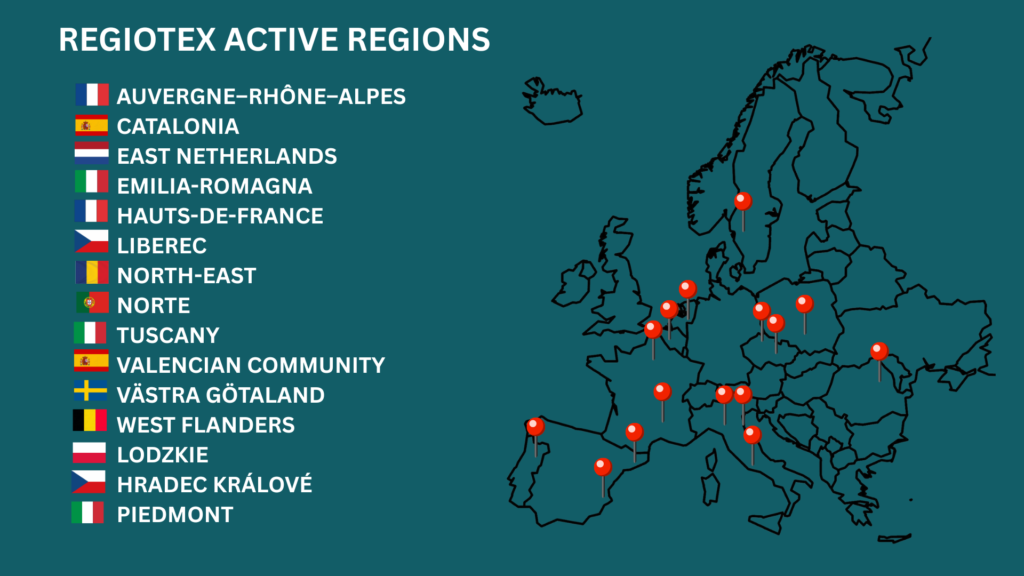
RegioTex currently brings together stakeholders from 15 regions and 32 organisations, forming an active core of textile regions that represent a significant share of Europe’s industrial and innovation capacity in the sector.
The network remains open to additional regions that share these objectives and are willing to engage through the public–private model described in this framework.
Are you a regional authority or industry organisation across Europe with an active textiles ecosystem? Reach out to us through the contact form below.
PURPOSE AND ADDED VALUE
Empowering regional authorities with comparative intelligence
Providing a structured interface between regional authorities and industry organisations
Strengthening cohesion and consistency across Europe’s textile regions
THEMATIC AREAS OF COOPERATION
Regional strategies and investment frameworks
Circularity implementation and environmental obligations
Industrial competitiveness and supply chain resilience
SME support instruments and business environment improvement